Fire pump in India: main, diesel and jockey pumps, NBC capacities, pump room rules, testing, maintenance and cost
Updated By Flamekite Editorial DeskFacts checked against official sources on
Fire pump in India: main, diesel and jockey pumps, NBC Table 7 sets of 1,620 to 2,850 l/min, IS 15301 pump room rules, daily checks and official rates.
- Jockey pump
- 180 l/min
- At least 3 percent of installed capacity, at most 10 percent (IS 15301 cl. 6.5)
- Pump numbers
- Office of 15 m to 24 m
- 2,280 l/min
- One electric and one diesel pump plus a 180 l/min jockey (Table 7 Note 10)
- Pump sets by building
- Main pump, 2,400 l/min at 76 m
- Rs 2,86,931
- Maharashtra PWD CSR 2018-19, supplied and commissioned, GST extra
- Official rates
Quick answer
A fire pump is the dedicated pump set that keeps a building's hydrants, risers and sprinklers charged with water under pressure. Indian pump houses hold three kinds: an electric main pump, a standby of the same capacity driven by a diesel engine or a second power source, and a small jockey pump that makes up leaks, all starting on their own when pressure falls and stopped only by hand (IS 15301:2003, cl. 3, 5.4).
IS 15301 lists pump sizes of 450, 900, 2,280, 2,850 and 4,500 litres a minute, and 6,700 for special risks; the jockey pump is 3 to 10 percent of the installed capacity and never under 180 litres a minute. NBC 2016 Table 7 picks the set by building, from a 900 l/min terrace pump for 15 m to 35 m flats to 2,850 l/min pumps for offices above 30 m.
Free, on WhatsApp. Or a free fire NOC check
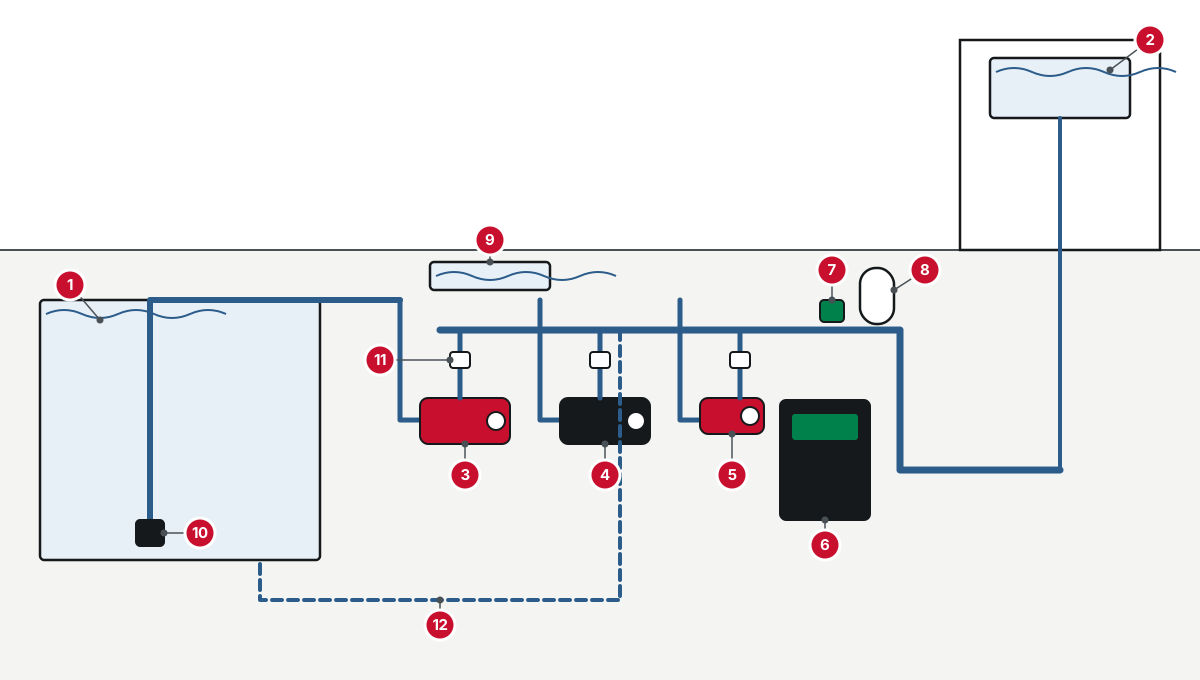
- Static water tank
- Terrace tank
- Main fire pump
- Standby pump
- Jockey pump
- Pump panel
- Pressure switch
- Air vessel
- Priming tank
- Foot valve and strainer
- Circulation relief valve
- Test line
Fire pump IS code and key numbers at a glance
| What | The rule | Source |
|---|---|---|
| Fire pump installation and maintenance | IS 15301:2003, Code of Practice, listed by BIS as current on 24 October 2026 | BIS standards database |
| Pump sizes in the code | 450, 900, 2,280, 2,850 and 4,500 l/min; 6,700 l/min for special risks (cl. 6.1) | IS 15301:2003 |
| Terrace pumps | The 450 and 900 l/min sizes, feeding a down-comer from the terrace tank (cl. 6.1) | IS 15301:2003 |
| Jockey pump size | 3 to 10 percent of installed pumping capacity, never below 180 l/min (cl. 6.5) | IS 15301:2003 |
| Standby pump | Same capacity as the main pump, on a diesel engine or another power source (cl. 3.8) | IS 15301:2003 |
| Overload duty | More than 65 percent of rated head at 150 percent of rated flow (cl. 6.7) | IS 15301:2003 |
| Shut-off head | At most 120 percent of rated head (horizontal pumps), 140 percent of bowl head (vertical turbine) (cl. 6.7) | IS 15301:2003 |
| Suction velocity | At most 1.5 m/s at rated flow; 2 m/s where the pump sits below the water level (cl. 6.9) | IS 15301:2003 |
| Pump house clearance | 6 m from other buildings, or a 4 hour wall with an RCC roof at least 100 mm thick (cl. 6.12) | IS 15301:2003 |
| Stopping the main pump | Only by a manual push button on the panel (cl. 5.4; IS 3844 cl. 4.2.2) | IS 15301:2003 |
Types of fire pump: main electric, diesel standby, jockey and terrace pump
| Option | Job | Starts on | Size | Where it sits | Source |
|---|---|---|---|---|---|
| Main (duty) pump | Charges the wet riser, yard hydrants or sprinklers during a fire | Its own low-pressure switch after the jockey cannot hold pressure | 1,620 to 2,850 l/min in the Table 7 notes; 4,500 or 6,700 l/min for big risks | Pump house at the underground tank | IS 15301:2003 |
| Diesel standby pump | Takes over when mains power fails | Its own low-pressure switch (cl. 5.5) | Same as the main pump (cl. 3.8) | Same pump room or the room next to it, with its own panel and battery | IS 15301:2003 |
| Jockey pump | Makes up small leaks so the main pump does not start for nothing | Upper and lower pressure limits on its own switch (cl. 5.4) | 3 to 10 percent of installed capacity, at least 180 l/min | Pump house, on the same suction | IS 15301:2003 |
| Terrace pump | Feeds the down-comer from the terrace tank | Pressure drop when a landing valve or hose reel opens | 450 or 900 l/min (cl. 6.1) | Terrace, gate valve on suction, non-return valve on delivery (cl. 3.6) | IS 15301:2003 |
| Second electric pump | Adds capacity in the bigger Table 7 rows | Pressure drop, in sequence | 2,280 l/min under Note 11 | Pump house, beside the first | NBC 2016, Table 7 |
Fire pump installation in 8 steps, from sizing to handover
Read the Table 7 row
Occupancy, height and floor area fix the pump set: a terrace pump, or a main, standby and jockey at the underground tank.
Choose the pump and motor together
Match the pump to the motor speed; electric pumps up to 2,280 l/min usually run at 2,900 rpm as single-stage end-suction sets (IS 15301 cl. 6.2).
Site the pump house
Outside the building and 6 m clear, or behind a 2 hour wall and 1 hour door on the ground floor or basement, with access from outside (cl. 4.1, 4.5).
Pour the foundation
M15 reinforced concrete, 50 mm thick for pumps to 900 l/min, 75 mm to 2,280 and 100 mm to 4,500, with 150 mm spare in front and behind (cl. 6.4).
Lay suction and delivery
An independent suction for each pump, one connection from each tank compartment, a pressure gauge before the non-return valve and a test line (cl. 6.6, 6.8, 6.11).
Wire the panels
Floor-mounted panel with auto-manual switch, pressure switches on an air vessel, a separate diesel panel interlocked with it, and a supply taken before the main LT breaker (cl. 5.2 to 5.4, 6.15).
Test and record
Record flow at 7 kgf/cm², flow at 4.5 kgf/cm² and the gauge at 120 percent of 7 kgf/cm² in the pump house register (cl. 7.2.1).
Fire officer's inspection
The officer runs the pumps on site against the approved plan before the final fire NOC; in Maharashtra the licensed agency signs Form A for the building.
Fire pump room parts name: 12 items in a pump house
IS 15301 defines the parts of a fire pump installation in clause 3 and places them in clauses 5 and 6.
- Static water tank
- Underground or surface tank that stores water for fire fighting only (cl. 3.1). IS 15301:2003
- Terrace tank
- Concrete, masonry, plastic or steel tank on the roof that feeds the terrace pump (cl. 3.2). IS 15301:2003
- Main fire pump
- Electric or diesel pump at the static tank that charges the wet riser or sprinklers (cl. 3.7). IS 15301:2003
- Standby pump
- Pump of the same capacity on a diesel engine or another power source (cl. 3.8). IS 15301:2003
- Jockey pump
- Small pump that starts on a drop in static pressure and stops when the preset pressure is back (cl. 3.5). IS 15301:2003
- Pump panel
- Panel with the starting, stopping and indicating devices, floor mounted and compartmentalised, with a copper busbar and 1.8 mm sheet (cl. 3.9, 5.2). IS 15301:2003
- Pressure switch
- Switch on the delivery line or air vessel that starts the main or jockey pump when pressure falls below its setting (cl. 3.10). IS 15301:2003
- Air vessel
- Pressure vessel in the pump house carrying the two pressure switches (cl. 5.4). IS 15301:2003
- Priming tank
- Small tank above the pumps that keeps the casing and suction full where the pump lifts water (cl. 3.3). IS 15301:2003
- Foot valve and strainer
- Inward-opening valve at the suction strainer for a lifting pump; a plain strainer on flooded suction (cl. 3.4). IS 15301:2003
- Circulation relief valve
- Opens below shut-off pressure to circulate about 3 to 5 percent of rated flow so a pump on closed delivery does not overheat (cl. 3.11, 6.11). IS 15301:2003
- Test line
- Line and shut-off valve on each pump to test it without discharging into the system (cl. 6.11). IS 15301:2003
How a fire pump and jockey pump work: the pressure sequence
The system sits charged and still. Each pump starts on its own falling pressure, and only a person can stop the main pump.
1. Charged and idle
Air vessel and pipework hold the set pressure. Every pump stands on Auto, preset to the pressure the risk needs (cl. 6.1). IS 15301:2003
2. Small leak: jockey runs
A dripping valve lowers pressure to the jockey switch's lower limit; the jockey pump restores it and stops at the upper limit (cl. 5.4). IS 15301:2003
3. Outlet opens: main pump starts
A landing valve, hose reel or sprinkler head opens and pressure falls past the main pump's lower limit, which has no upper limit (cl. 5.4). IS 15301:2003
4. Power fails: diesel starts
The diesel pump starts on its own low-pressure switch; its interlock stops the electric and diesel pumps running together (cl. 5.3, 5.5). IS 15301:2003
5. Fire out: stopped by hand
The main pump keeps running until someone presses the manual stop on the panel (cl. 5.4). IS 15301:2003
Fire pump capacity as per NBC 2016 Table 7, by building
Table 7's notes name the pump set for each row: a terrace pump for low buildings, then electric and diesel pumps with a 180 l/min jockey. These rows were read off the printed pages.
| Pump set | Table 7 note | |
|---|---|---|
| Flats and hostels, 15 m to 35 m NBC 2016, Table 7 | 900 l/min terrace pump on a 25,000 litre terrace tank | Row itself |
| Hotel under 15 m, floors 300 to 1,000 m² NBC 2016, Table 7 | One electric and one diesel pump of 1,620 l/min, 180 l/min jockey | Note 14 |
| Office above 10 m to 15 m NBC 2016, Table 7 | Pumps of 1,620 l/min | Note 14 |
| Office or shops above 15 m to 24 m NBC 2016, Table 7 | One electric and one diesel pump of 2,280 l/min, 180 l/min jockey | Note 10 |
| Office above 30 m NBC 2016, Table 7 | Pumps of 2,850 l/min | Note 12 |
| School above 24 m to 30 m BIS, NBC 2016 Part 4 | Electric and diesel pumps of 1,620 l/min, 180 l/min jockey | Note 14 |
| Moderate hazard factory (G-2) over 1,000 m² BIS, NBC 2016 Part 4 | Two electric and one diesel pump of 2,280 l/min | Note 11 |
| High hazard factory (G-3) of 300 to 500 m² BIS, NBC 2016 Part 4 | Pump sets of 2,280 l/min | Note 10 |
Note 12's pump set is 2,850 l/min with a 180 l/min jockey. The 1,620 l/min size in Note 14 is not one of IS 15301's listed sizes; the Table 7 note governs where the state applies the code. Rows not shown are on the NBC 2016 page.
Fire pump performance numbers: flow, head and shut-off
Six figures from IS 15301 decide whether a pump is fit for fire duty and how it is tested at handover.
150 percent
Of rated flow at which the pump must still give more than 65 percent of rated head (cl. 6.7) IS 15301:2003
120 percent
Most a horizontal pump's shut-off head may be of its rated head; 140 for vertical turbine (cl. 6.7) IS 15301:2003
180 l/min
Smallest jockey pump allowed, within 3 to 10 percent of installed capacity (cl. 6.5) IS 15301:2003
7 kgf/cm²
Pressure at which commissioning flow is recorded, again at 4.5 kgf/cm² (cl. 7.2.1) IS 15301:2003
2,900 rpm
Usual motor speed for electric fire pumps up to 2,280 l/min (cl. 6.2) IS 15301:2003
20 percent
Margin a sprinkler pump must exceed the calculated flow and pressure by (IS 15105 cl. 12.1(e)) BIS, IS 15105:2021
Fire pump room design rules from IS 15301 and IS 3844
Clauses 4 to 6 of IS 15301 and clause 4.2 of IS 3844 fix where the pump room goes and how it is built. Inspectors check these first.
Do
- Keep the pump room 6 m from surrounding buildings and overhead structures; if attached, build a 4 hour wall, an RCC roof at least 100 mm thick and an entrance from outside (IS 15301 cl. 6.12). IS 15301:2003
- Inside the building, use only the ground floor on the periphery or the basement, behind a 2 hour wall and a 1 hour fire check door, with forced ventilation and a ramp in a basement (cl. 4.5). IS 15301:2003
- Take the pump supply from the incoming side of the main LT breaker, so it stays live when the rest of the premises is switched off (cl. 6.15). IS 15301:2003
- Display the layout plan of the pumps and fire water lines in the pump house (cl. 5.1). IS 15301:2003
- Leave 1 m front and back and 0.75 m at the sides for pumps above 2,280 l/min, and 2.75 m headroom (IS 3844 cl. 4.2.2). BIS, IS 3844:1989
- Provide CO2 or powder extinguishers in the pump room, and sprinklers over pumps in a basement (IS 15301 cl. 6.16). IS 15301:2003
Don’t
- Do not install fire pumps in the open (cl. 6.12). IS 15301:2003
- Do not leave the diesel exhaust inside: take it out of the pump house and discharge it high in open air (cl. 4.2). IS 15301:2003
- Do not put a sluice valve in a pump's suction unless the pump sits below the water level (cl. 6.8). IS 15301:2003
- Do not feed the pumps from a sub-station or DG house within 6 m of other buildings without protecting their openings (cl. 6.13). IS 15301:2003
Diesel fire pump: engine, panel, battery and fuel rules
The diesel standby is what keeps water on a fire when the grid fails. IS 15301 and Maharashtra's guidelines set four rules for it.
cl. 5.3
Its own panel and battery
A separate panel in the pump room or the room next door, with its own battery, battery charger and auto-manual changeover. IS 15301:2003
cl. 5.3, 5.5
Interlocked, self-starting
Interlocked with the main panel so electric and diesel pumps do not run together, and started by its own low-pressure switch. IS 15301:2003
cl. 7.3.2
Fuel for 4 hours
Enough fuel of the right grade for 4 hours of running without refilling, checked weekly, with the sludge trap and battery. IS 15301 gives no tank size in litres. IS 15301:2003
MFS guidelines
Day tank checked at commissioning
Maharashtra's July 2026 Form B guidelines ask the engine to run 10 minutes with fuel in the day tank for 4 hours of running. MFS Form B guidelines
Fire pump testing and commissioning checklist
IS 15301 asks for the handover test to be written into a register kept in the pump house. These are the points to record.
- Flow at 7 kgf/cm², flow at 4.5 kgf/cm² (65 percent of 7) and the gauge reading at 120 percent of 7 kgf/cm², entered in the pump house register (IS 15301 cl. 7.2.1). IS 15301:2003
- The pump's nameplate shows head, capacity and speed, and a pressure gauge sits between the pump and the non-return valve (cl. 6.6). IS 15301:2003
- Pumps exceed the calculated sprinkler flow and pressure by at least 20 percent (IS 15105 cl. 12.1(e)). BIS, IS 15105:2021
- Diesel start test: fuel isolated, 6 cranking cycles of at least 15 seconds, then the fail-to-start alarm (IS 15105 cl. 14.7). BIS, IS 15105:2021
- Pump alignment checked after a 15 minute run. MFS Form B guidelines
- Flow at 7 kgf/cm² and 4.5 kgf/cm² displayed in the pump house at commissioning. MFS Form B guidelines
- Main pump stops only from the manual push button, and the duty and standby pumps are on different power sources (IS 3844 cl. 4.2.2, 4.2.6). BIS, IS 3844:1989
Fire pump maintenance checklist: daily, weekly and yearly
IS 15301 clause 7.3 sets the daily and weekly routine and names a responsible person to keep it (cl. 7.1).
Daily
Open a valve slightly and time how long the jockey pump takes to restore pressure. IS 15301:2003
Daily
Run the main pump for at least 5 minutes, started by letting pressure fall, and check glands and packing. IS 15301:2003
Weekly
Grease bearings, clean starter contacts and measure the motor circuit's insulation resistance. IS 15301:2003
Weekly
Start the diesel by cutting the power and letting pressure fall, run it 10 minutes, check fuel for 4 hours, the sludge trap and the battery. IS 15301:2003
Weekly
Check alignment, nuts, bolts and coupling guard after 15 minutes of continuous running. IS 15301:2003
Every 6 months
Measure pump motor insulation as part of the sprinkler system's 6-monthly checks (IS 15105 cl. 15.6.4(c)). BIS, IS 15105:2021
Fire pump price in India: official item rates
Flamekite’s working from the official rules; no government publishes this figure.
The Maharashtra PWD Current Schedule of Rates 2018-19 is the official public price list Flamekite could read: supplied, erected, tested and commissioned, GST extra.
As published
- Main pump, 1,400 l/min at 56 m, 30 HP (13-1-1)Rs 1,21,388 MH PWD CSR 2018-19, ch. 13
- Main pump, 1,800 l/min at 76 m, 50 HP (13-1-2)Rs 1,84,388 MH PWD CSR 2018-19, ch. 13
- Main pump, 2,400 l/min at 76 m, 75 HP, single stage (13-1-3)Rs 2,86,931 MH PWD CSR 2018-19, ch. 13
- Multi-stage pump, 2,800 l/min at 105 m, 120 HP (13-2-3)Rs 4,76,1752,800 l/min at 76 m: Rs 3,31,007 MH PWD CSR 2018-19, ch. 13
- Jockey pump, 240 l/min at 56 m, 15 HP (13-3-1)Rs 63,770At 105 m: Rs 1,16,026 MH PWD CSR 2018-19, ch. 13
- Terrace booster pump, 900 l/min at 40 m (13-4-4)Rs 53,809450 l/min at 35 m: Rs 34,680 MH PWD CSR 2018-19, ch. 13
- Priming tank, 1,000 litresRs 9,880 MH PWD CSR 2018-19, ch. 13
- Air vesselRs 10,773Pressure switch Rs 1,515; pressure gauge Rs 657 MH PWD CSR 2018-19, ch. 13
- Foot valve, 150 mmRs 16,114100 mm Rs 6,454 MH PWD CSR 2018-19, ch. 13
Rates are from 2018-19 and Maharashtra-specific, with a location uplift outside district headquarters. The schedule chapter Flamekite read has no line for a diesel engine pump set or a pump panel, so neither is priced here. CPWD's current Delhi Schedule of Rates for these items was not available to read.
Fire pump faults that hold up a fire NOC
Each fault below breaks a clause of IS 15301 or IS 3844 that a fire officer can see in the pump room.
If Main pump set to stop on its own when pressure recovers
Rewire so only the manual push button on the panel stops it (IS 15301 cl. 5.4). IS 15301:2003
If Pumps left on Manual
Put every pump on Auto, preset to the system pressure (cl. 6.1). IS 15301:2003
If Pump supply taken after the main breaker
Re-feed it from the incoming side so a premises shutdown does not cut the pumps (cl. 6.15). IS 15301:2003
If Diesel pump without its own battery and charger
Fit a separate panel with battery, charger and interlock (cl. 5.3). IS 15301:2003
If Jockey pump far bigger than 10 percent of the pumps
Resize it to between 3 and 10 percent, at least 180 l/min (cl. 6.5). IS 15301:2003
If No pump house register or commissioning flows
Run and record the 7 and 4.5 kgf/cm² flows and keep the register in the pump house (cl. 7.2.1). IS 15301:2003
If Diesel tank short of 4 hours of fuel
Top it up and log the weekly check (cl. 7.3.2). IS 15301:2003
Fire pump myths the codes contradict
Four claims owners repeat about fire pumps that the codes do not support.
You may have read
The jockey pump is a small fire pump that fights the fire.
Myth
What the sources say
It only makes up leaks between its two pressure limits; the main pump does the fire duty (IS 15301 cl. 3.5, 5.4). IS 15301:2003
You may have read
A pump that gives its rated flow is good enough.
Myth
What the sources say
It must also give more than 65 percent of rated head at 150 percent of rated flow, and keep its shut-off head within 120 percent (cl. 6.7). IS 15301:2003
You may have read
The diesel pump can be smaller than the electric one.
Myth
What the sources say
The standby pump is of the same capacity as the fire pump (cl. 3.8). IS 15301:2003
You may have read
IS 3844 and IS 15301 agree on the priming tank.
Myth
What the sources say
IS 15301 asks at least 3 times the suction pipe and casing volume (cl. 6.10); IS 3844 asks 8 times the suction pipe volume (cl. 4.2.4). Use the larger unless your approval says otherwise. IS 15301:2003
Fire pump set for 3 buildings: worked examples
Flamekite's reading of Table 7 and IS 15301 in states that name NBC 2016. Your fire service's reading prevails.
Case 1
A 20 m block of flats
Group A-4, ground plus 6, top floor 20 m.
What applies The 15 m to 35 m row: a 900 l/min terrace pump on a 25,000 litre terrace tank feeding a down-comer. No pump house at ground level until the building passes 35 m. NBC 2016, Table 7
Case 2
A 22 m office building
Group E business, 22 m, no basement.
What applies Note 10: one 2,280 l/min electric pump, one 2,280 l/min diesel standby and a 180 l/min jockey on a 1,00,000 litre underground tank. 180 l/min is about 4 percent of the 4,560 l/min installed, inside IS 15301's 3 to 10 percent band. NBC 2016, Table 7
Case 3
A 1,500 m² moderate hazard factory
Group G-2, one storey.
What applies Note 11: two electric pumps and one diesel pump of 2,280 l/min with a 180 l/min jockey, on a 1,50,000 litre underground tank. BIS, NBC 2016 Part 4
Which rule sets your fire pump: NBC, IS 15105 or the state
IS 15301 says how to install and keep a pump; the building rule your state applies says which pumps you need.
IfYour state names NBC 2016 in its fire law
Table 7's row and its pump note set the pump set; IS 15301 governs how it is installed and kept. NBC 2016 NBC 2016, Table 7
IfYour sprinkler hazard is not covered by Table 7
IS 15105:2021 sizes sprinkler pumps and storage, with 30, 60 or 120 minutes of pump running by hazard (Table 30). IS 15105 BIS, IS 15105:2021
IfYour building is in Maharashtra
Schedule-I of the 2006 Act sets the pump sets by row; a licensed agency installs and certifies them. Fire NOC Maharashtra MH Act 2023 Schedule-I
IfYour building is in Assam, or a UP workplace of 5+ floors or 20 m+
NBCS 2026 Part F applies through the Assam fire Act or rule 12 of the UP OSH Rules 2026. NBC 2026 UP Gazette
IfYour building is very tall
NBC 2016 Annex E asks intermediate tanks and pumps at 160 to 180 m once a building passes 150 to 175 m. High Rise Building Height as per NBC NBC 2016, Annex E
What Flamekite could not confirm about fire pumps
Five facts a reader would expect here are not stated, because no official text was available to read on 29 October 2026.
- A BIS product specification for the fire pump set itself: not read, so no product standard number is given.
- Diesel day tank size in litres: IS 15301 and the MFS guidelines ask for 4 hours of running, not a volume.
- Jockey and main pump cut-in and cut-out pressures: no code read sets them; IS 15301 says each is preset to the risk.
- HSN code and GST rate for fire pumps and pump panels: not confirmed from a CBIC or GST Council notification.
- Current CPWD Delhi Schedule of Rates (E&M) for fire pumps: the rates above are Maharashtra's 2018-19 schedule instead.
Questions about fire pumps in India
What is a fire pump?
What is a jockey pump and why is it needed?
How do a fire pump and jockey pump operate together?
What is the fire pump capacity as per NBC?
Which IS code applies to fire pumps?
What is the diesel tank capacity for a fire pump?
What are the parts of a fire pump room?
Where should the fire pump room be?
How often should a fire pump be tested?
What does a fire pump flow test check?
What is the fire pump price in India?
Fire pump kya hota hai?
Keep reading
- Fire fighting systemHow pumps, tanks, risers, sprinklers and alarms fit together.
- Fire hydrant systemWet risers, landing valves and yard hydrants the pumps feed.
- Fire sprinkler systemHazard classes, IS 15105 design and sprinkler pump duty.
- Fire tank capacity calculatorUnderground and terrace tank sizes by building.
- IS 3844: hydrants and hose reelsPump house, clearances and the 700 kPa test.
- NBC 2016 Part 4Table 7 rows with tanks and pump notes.
- Fire AMCHow daily and weekly pump checks become a contract.
- Form B fire certificateMaharashtra's twice-yearly certificate that covers the pumps.
Free tools for this
- Fire Pump CalculationFire pump calculation for your building: the main, diesel and jockey pumps NBC 2016 Table 7 names, IS 15301 head checks and the diesel fuel rule
- Fire tank calculatorFire tank capacity calculation for your building: the underground and terrace tank in litres and the fire pump set, from the NBC 2016 Table 7 row
- Fire Fighting System Cost EstimateFire fighting system cost estimate at official rates: enter sprinkler heads, hydrants, detectors, pumps and pipe for a BOQ at Maharashtra PWD schedule rates
- Fire Extinguisher HSN Code and GST RateHSN and SAC codes with GST rates for fire extinguishers, pumps, hoses, alarms, AMC, audit and fire NOC consultancy, read from the CBIC rate notifications
Words on this page, explained
Keep exploring
The codes and laws behind it
Sources
Each source was opened and read on the date shown. How Flamekite checks its sources
- Bureau of Indian Standards (copy published by Public.Resource.Org): IS 15301:2003, Installation and Maintenance of Fire Fighting Pumps, Code of Practice (Fire Fighting Sectional Committee CED 22, April 2003, reaffirmed): clauses 3 to 7, pump house, panels, capacities, suction, performance and maintenance (opens in a new tab)
- Bureau of Indian Standards: IS 3844:1989, Code of Practice for Installation and Maintenance of Internal Fire Hydrants and Hose Reels on Premises (first revision, reaffirmed 2020); free download after registration; clause numbers cited on the page (opens in a new tab)
- Bureau of Indian Standards: IS 15105:2021, Design, Installation and Maintenance of Fixed Automatic Sprinkler Fire Extinguishing Systems, Code of Practice (first revision), July 2021; free download after registration; clause and table numbers cited on the page (opens in a new tab)
- Bureau of Indian Standards (BIS-licensed copy hosted by Nagpur Municipal Corporation): National Building Code of India 2016, Part 4, Table 7 Minimum Requirements for Fire Fighting Installations: every row, Groups A to J, and Notes 1 to 24, printed pages 41 to 51, read off the page images (opens in a new tab)
- Bureau of Indian Standards, Know Your Standards database: Status, publication and withdrawal dates of the fire standards named on /is-codes (IS 2190, 15683, 16018, 2189, 15105, 9972, 3844, 13039, 9668, 15301, 15908, 636, 884, 903, 5290, 9457, 3614, 11360, 2175 and others), read 24 October 2026 (opens in a new tab)
- Maharashtra Fire and Emergency Services: Guidelines for Form B, Annexure A: to be followed by licensed agencies issuing Form B under section 3(3) and rule 4(2) (circular of 7 July 2026) (opens in a new tab)
Show all 13 sourcesShow fewer
- Public Works Department (Electrical Wing), Government of Maharashtra (copy hosted by Chhatrapati Sambhajinagar Municipal Corporation): Current Schedule of Rates 2018-2019 (in force from 12 September 2018), chapter 13 Fire Fighting and Fire Alarm System: items 13-1-1 to 13-10-3 (fire pumps, jockey and booster pumps, GI pipe, valves, hydrant valves, hose reels, hoses, branch pipes, fire brigade inlets, cabinets, conventional fire alarm, PA system and sprinkler items), rates per unit before GST, printed pages 223 to 231 (opens in a new tab)
- Bureau of Indian Standards (copy hosted by Puducherry Fire Service): National Building Code of India 2016, Part 4, Table 7: business (E) and mercantile (F) rows and Notes 4, 6, 10 to 12, 14 and 16, printed pages 46, 47 and 51 (read off the page images) (opens in a new tab)
- Bureau of Indian Standards (BIS-licensed copy hosted by Nagpur Municipal Corporation): National Building Code of India 2016, Part 4: clause 3.1.3 (Group B, B-1 and B-2), Table 7 educational rows and Notes 4, 6, 14 and 16, clause 6.2 (educational buildings); Table 7 read off the page-43 image (opens in a new tab)
- Bureau of Indian Standards (BIS-licensed copy hosted by Nagpur Municipal Corporation): National Building Code of India 2016, Part 4: Table 7 industrial buildings (Group G) rows G-1 to G-3 and Notes 4 to 24, read off the page images, pp. 47 to 51 (opens in a new tab)
- Government of Maharashtra (gazette copy hosted by Maharashtra Fire and Emergency Services): Maharashtra Fire Prevention and Life Safety Measures (Amendment) Act, 2023, substituted Schedule-I: minimum fire fighting installations for apartment houses (A-4) by height, with Notes 1, 4, 6, 10, 11 and 15 (read off the page images, pp. 13 to 15 and 32 to 34) (opens in a new tab)
- Uttar Pradesh Gazette Extraordinary, 27 August 2026, English translation (copy hosted by TeamLease RegTech): Uttar Pradesh Occupational Safety, Health and Working Conditions Rules, 2026, Notification No. 962/XXXVI-03-2026-1903305: rules 12, 16, 43, 45, 46, 47 and 127 (opens in a new tab)
- Bureau of Indian Standards (BIS-licensed copy hosted by Nagpur Municipal Corporation): National Building Code of India 2016, Part 4: clause 4.10 (Fire Officer), clause 6.4.2.2 (D-6 refuge areas) and Annex E Additional Requirements for High Rise Buildings, E-1 to E-6, printed pages 52, 64, 87 and 88, read off the page images (opens in a new tab)