Fire sprinkler system in India: types, where the code requires it, IS 15105 design, installation, tests, upkeep and cost
Updated By Flamekite Editorial DeskFacts checked against official sources on
Fire sprinkler system in India: wet, pre-action and deluge types, where NBC Table 7 requires them, IS 15105 design (12 m² a head, 5 lpm/m²), tests and rates.
- Ordinary hazard density
- 5 lpm/m²
- Over at most 360 m² operating at once (IS 15105 cl. 8.1.2)
- Design numbers
- Basement trigger
- 200 m²
- Low buildings need sprinklers in a basement above this (NBC 2016 Table 7)
- Table 7 rows
- Acceptance pressure test
- 120 minutes
- At 150 percent of maximum working pressure (cl. 14.2)
- Acceptance tests
- 68 °C bulb sprinkler head
- Rs 396
- Supplied, erected and tested; Maharashtra PWD CSR 2018-19, GST extra
- Official rates
Quick answer
A fire sprinkler system is a network of pipes with heat-sensitive heads that open one by one over a fire and spray water, fed by a dedicated tank and pumps through an installation valve that also sounds an alarm gong. India designs it to IS 15105:2021, which sorts buildings into light, ordinary, high and storage hazard and sets, for example, 5 litres a minute per m² with at most 12 m² a head for ordinary hazard (cl. 8.1, 9.17).
Under NBC 2016 Table 7, most low buildings need sprinklers only in a basement over 200 m², while offices and shops above 15 m, hospitals, five-star hotels, malls, factories over 1,000 m², warehouses over 250 m² and flats above 45 m need them throughout. Your state rule and NOC conditions decide the final list.
Free, on WhatsApp. Or a free fire NOC check
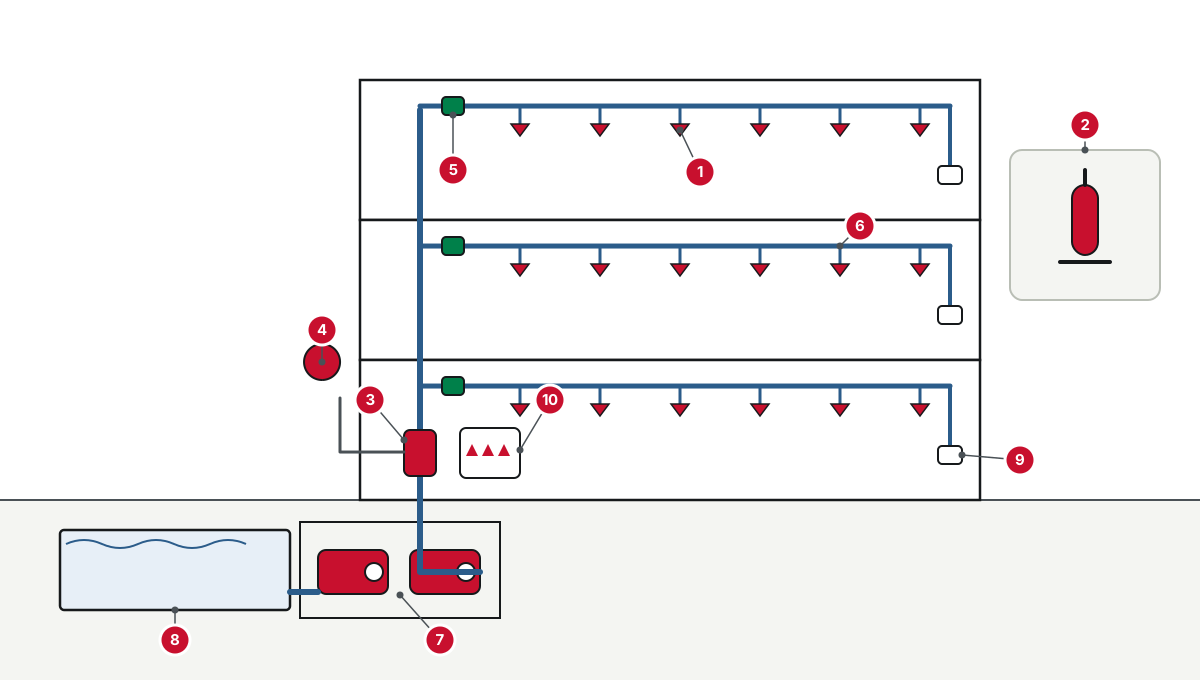
- Sprinkler head
- Glass bulb colour
- Installation (alarm) valve set
- Water motor alarm gong
- Flow switch
- Distribution and range pipes
- Fire pumps
- Water tank
- Spare heads and wrench
- Test and drain valve
Fire sprinkler system code and key numbers at a glance
| What | The rule | Source |
|---|---|---|
| Standard | IS 15105:2021, Design, Installation and Maintenance of Fixed Automatic Sprinkler Fire Extinguishing Systems, first revision, July 2021 | BIS, IS 15105:2021 |
| Replaced | IS 15105:2002, withdrawn on 14 March 2022 | BIS, IS 15105:2021 |
| Not covered | Water spray and deluge design (IS 15325, IS 15519), and ships, aircraft, vehicles and mines (cl. 1.4, 1.5) | BIS, IS 15105:2021 |
| Water and pumps for most buildings | Taken from Table 7 of NBC Part 4; the code's own tank and pump tables apply only where that table is silent (cl. 1.6) | BIS, IS 15105:2021 |
| Hazard classes | Light, ordinary, high and storage (cl. 5.1) | BIS, IS 15105:2021 |
| Maximum pressure in an installation | 7 bar (cl. 10.3.3) | BIS, IS 15105:2021 |
| Height of one installation | 45 m; above it the high-rise rules of Annex B apply (cl. 6.5) | BIS, IS 15105:2021 |
| BIS mark for sprinkler heads | Not compulsory: IS 9972 heads had only a draft Quality Control Order on 24 October 2026 | BIS, IS 15105:2021 |
| Travel distance bonus | 50 percent more travel distance allowed in a fully sprinklered building (NBC 2016 Table 5, Note 1) | NBC 2016, Part 4 |
| Life CPWD assigns a sprinkler system | 20 years | CPWD Maintenance Manual |
Types of fire sprinkler system: wet, dry, pre-action, deluge and recycling
| Option | Pipe above the valve | What opens the water | Where it is used | Source |
|---|---|---|---|---|
| Wet pipe | Always full of water under pressure (cl. 3.29) | Heat breaks the head's bulb or link; water flows at once | Heated buildings: offices, hotels, hospitals, shops, warehouses | IS 15105:2002 (withdrawn) |
| Dry pipe | Air under pressure | A head opens, air escapes, the valve admits water | Allowed as an alternative type (cl. 16.1 note) where pipes could freeze | IS 15105:2002 (withdrawn) |
| Pre-action | Dry, often with supervisory air | A separate detection system opens the alarm valve first (cl. 3.27) | Recommended for computer and data rooms, where an accidental discharge is costly (cl. 11.12.3) | IS 15105:2002 (withdrawn) |
| Recycling | Dry | Heat detectors open and close the valve repeatedly (cl. 3.28) | To limit water damage after the fire is out (cl. 16.4) | IS 15105:2002 (withdrawn) |
| Deluge | Dry, with open heads | Detection opens a deluge valve; every head discharges | Where water must cover the whole area a fire may start in (cl. 16.6); outside IS 15105:2021, which sends spray and deluge to IS 15325 and IS 15519 | IS 15105:2002 (withdrawn) |
Fire sprinkler system installation in 8 steps
Read the Table 7 row
Occupancy, height and floor area decide whether sprinklers go in the basement only or the whole building, and the tank and pump set.
Classify the hazard
Light, ordinary, high or storage under IS 15105 clause 5; an unlisted risk goes to the authority in writing before design (cl. 5.6).
Size the pipes
Tables may be used only for light and ordinary systems up to 5,000 m² and not gridded; everything else is hydraulically calculated (cl. 10.3).
Get the layout approved
Submit the sprinkler drawings with the fire plan for the provisional approval your state runs.
Install pumps, valves and pipework
Pumps exceed the calculated flow and pressure by at least 20 percent (cl. 12.1(e)); the installation valve set carries the alarm gong and gauges.
Fit and space the heads
Choose K-factor and temperature rating per Table 1 and cl. 7.7, and keep within the coverage and spacing limits of cl. 9.17.
Run the acceptance tests
Pressure test, flushing, full-flow test, diesel start sequence and alarm checks of clause 14, recorded for the authority.
Certify and get the final NOC
The installer certifies the work (Form A by a licensed agency in Maharashtra) and the fire officer inspects before the final NOC.
Fire sprinkler system components: 10 parts and their job
A sprinkler installation is a set of main control valves with the pipes and heads downstream of it (IS 15105:2002, cl. 3.26), plus the water supply that feeds it.
- Sprinkler head
- A sealed nozzle that opens at its rated temperature; orifices are 10, 15, 20 or 25 mm (IS 15105 cl. 7.4). BIS, IS 15105:2021
- Glass bulb colour
- Shows the rating: orange 57 °C, red 68 °C, yellow 79 °C, green 93 °C (Table 3). BIS, IS 15105:2021
- Installation (alarm) valve set
- The control valve, alarm valve, gauges and drain for one installation; gauges above and below it are read daily (cl. 15.6). BIS, IS 15105:2021
- Water motor alarm gong
- Sounds within 45 to 60 seconds of water flowing (cl. 11.10(b)), at least 85 dB above background noise (cl. 14.8(b)). BIS, IS 15105:2021
- Flow switch
- Signals the fire panel which zone is flowing; signals must reach the panel at acceptance (cl. 14.9). BIS, IS 15105:2021
- Distribution and range pipes
- The pipe grid feeding heads; arm pipes are kept to 32 mm bore where the feed is over 65 mm (cl. 10.1(c)). BIS, IS 15105:2021
- Fire pumps
- Direct-coupled, never belt-driven, with an engine pump backing an electric one (cl. 12.1(b), (f)). BIS, IS 15105:2021
- Water tank
- Sized from the Table 7 row for most buildings; a reservoir of 225 m³ or more needs two interconnected compartments (cl. 13.3(e)). BIS, IS 15105:2021
- Spare heads and wrench
- Kept at 38 °C or less: 5 light, 15 ordinary, 30 high hazard near a state capital, more elsewhere (cl. 7.10, Table 5). BIS, IS 15105:2021
- Test and drain valve
- Used to prove the alarm and the water supply; the full-flow test opens a head or the pump-room test line (cl. 14.5). BIS, IS 15105:2021
How a fire sprinkler system works: from heat to alarm in 5 stops
Only the heads heated past their rating open. The rest stay shut, which is why a sprinkler fire uses far less water than a hose.
1. Heat reaches the ceiling
The head's rating is at least 30 °C above the hottest ceiling temperature expected, so normal heat never opens it (cl. 7.7.1). BIS, IS 15105:2021
2. The bulb or link breaks
A red bulb gives way at 68 °C; that head alone starts to spray. BIS, IS 15105:2021
3. Water flows through the valve
Water moving through the installation valve set feeds the alarm gong and trips the flow switch, whose signal must reach the fire panel (cl. 14.9). BIS, IS 15105:2021
4. The gong and panel sound
Within 45 to 60 seconds of flow the gong must ring (cl. 11.10(b)). BIS, IS 15105:2021
5. The pump keeps pressure
Falling pressure starts the main pump, which runs until stopped by hand; the tank holds 30 to 120 minutes of pump running by hazard where IS 15105 sets the storage (Table 30). BIS, IS 15105:2021
Where NBC 2016 Table 7 requires a fire sprinkler system
Table 7 has a sprinkler column for every occupancy and height. In low buildings it usually points to Note 4: sprinklers only in a basement over 200 m². These rows were read off the printed pages.
| Sprinklers | Underground tank (litres) | |
|---|---|---|
| Flats and hostels under 35 m | Basement over 200 m² only | None |
| Flats and hostels, above 35 m to 45 m | Basement, fed from both tanks | 75,000 |
| Flats and hostels above 45 m | Whole building | 1,50,000 to 2,00,000 |
| Hotel under 15 m, floor up to 1,000 m² | Basement over 200 m² only | None to 50,000 or more |
| Hotel under 15 m, floor over 1,000 m²; five-star hotel | Whole building | 1,00,000; 2,50,000 |
| School under 24 m | Basement over 200 m² only | None |
| Hospital with beds above ground plus 2, or 15 m to 24 m | Whole building | 75,000; 1,50,000 |
| Office or shops above 15 m | Whole building | 1,00,000 to 2,00,000 |
| Mall with cinemas or food courts | Whole building | 2,00,000 |
| Moderate hazard factory over 1,000 m² | Whole building | 1,50,000 |
| Warehouse under 15 m, over 250 m² | Whole building | 50,000 |
| Multi-level car park | Whole building | 1,50,000 |
Annex E adds sprinklers to every refuge area, and above 120 m for homes and 60 m for other buildings sprinklers are fed from a main and an alternate riser. In Maharashtra, Note 21(a) of Schedule-I sends large storage and industrial sprinkler design to IS 15105. NBC 2016, Table 7
Fire sprinkler hazard classification: which class your building is
IS 15105 clause 5 puts every occupancy in one of 4 classes, and the class sets density, coverage and water. Find yours below.
IfOffices, hotels, hospitals, schools, libraries, museums, places of worship, prisons or homes
Light hazard, but only where no compartment exceeds 126 m² and compartments have 30 minute walls and doors; otherwise ordinary (cl. 5.2.2, 5.6.1). Kitchens, stores and utilities are excluded. Hotels BIS, IS 15105:2021
IfShops, car parks inside buildings, airport terminals, metro stations, laboratories, garages, garment and electronics units, bakeries
Ordinary hazard (cl. 5.3, 5.6.2); the list is not complete, so ask the authority about an unlisted risk before design. Malls and shops BIS, IS 15105:2021
IfProcesses with a high fire load that spreads fast
High hazard (cl. 5.4.1); some need water spray under IS 15325 instead (cl. 5.4.2). Factories BIS, IS 15105:2021
IfWarehouses stacked above ordinary hazard heights
Storage hazard by commodity category, with Annex C densities; ESFR heads reach storage up to 13.7 m (cl. 5.5, Table 1). Warehouses BIS, IS 15105:2021
IfA hospital ward block
Light hazard if the compartment rule is met; Table 7 still asks for sprinklers in the whole building once beds sit above ground plus 2. Hospitals NBC 2016, Table 7
IfA small higher-hazard area inside a larger occupancy
If it is 40 m² or less it follows the dominant occupancy (cl. 13.2). BIS, IS 15105:2021
Fire sprinkler design numbers: density, coverage and spacing
Clauses 8.1 and 9.17 of IS 15105 set the water each square metre gets and how much ceiling one standard head may cover.
2.25 lpm/m²
Light hazard density, over at most 84 m² operating (cl. 8.1.1) BIS, IS 15105:2021
5 lpm/m²
Ordinary hazard density, over at most 360 m² (cl. 8.1.2) BIS, IS 15105:2021
12.2 lpm/m²
High hazard density, over at most 260 m² (cl. 8.1.3) BIS, IS 15105:2021
21 m²
Most ceiling one standard head may cover in light hazard; 12 m² ordinary, 9 m² high (cl. 9.17.1) BIS, IS 15105:2021
4.5 m
Most distance between heads in light and ordinary hazard; 3.75 m in high (cl. 9.17.2) BIS, IS 15105:2021
1.8 m
Least distance between heads, so one does not wet the next (cl. 9.17.3) BIS, IS 15105:2021
Fire sprinkler system for warehouses, hotels, hospitals and offices
Each building page sets out the full NOC regime; these are the sprinkler points that differ by use.
Storage
Warehouses and godowns
Table 7 wants sprinklers throughout once a ground-floor warehouse passes 250 m², and bars storage above 15 m (Note 20). Racked storage is designed by commodity category to Annex C. NBC 2016, Table 7
Hotels
Hotels and five-star hotels
Basement only up to 1,000 m² floors below 15 m; whole building beyond that, and in every five-star hotel. IS 15105 adds a 32 mm minimum pipe for hotel rooms (cl. 10.1(d)). NBC 2016, Table 7
Hospitals
Hospitals and nursing homes
Whole building once beds are above ground plus 2 on a plot up to 1,000 m², and in every hospital of 15 m to 24 m. NBC 2016, Table 7
Offices
Offices and commercial towers
Whole building above 15 m; below 10 m only a basement over 200 m². Offices count as light hazard only where compartments stay under 126 m². NBC 2016, Table 7
Factories
Factories
Whole building for moderate hazard factories over 1,000 m²; high hazard processes may need water spray instead. NBC 2016, Table 7
Fire sprinkler head selection and placement: do's and don'ts
Most site rejections come from the wrong head in the wrong place. These IS 15105 rules prevent them.
Do
- Pick a temperature rating at least 30 °C above the highest expected ceiling temperature (cl. 7.7.1). BIS, IS 15105:2021
- Use 141 °C roof heads over high-piled storage (cl. 7.7.2). BIS, IS 15105:2021
- Match K-factor to hazard and height: K 80 or 115 for ordinary hazard up to 9 m, K 115 from 9 to 15 m (Table 1). BIS, IS 15105:2021
- Keep heads at least 100 mm from a wall (cl. 9.17.5) and the deflector 75 to 450 mm below a non-combustible ceiling (Table 8). BIS, IS 15105:2021
- Fit an approved metal guard where a head can be knocked (cl. 7.9(a)). BIS, IS 15105:2021
Don’t
- Do not paint, coat or load a head; every head is inspected for position, loading and corrosion at least every 6 months (cl. 15.6.4). BIS, IS 15105:2021
- Do not place heads closer than 1.8 m apart (cl. 9.17.3). BIS, IS 15105:2021
- Do not run water pipes over salt baths, metal melt pans, frying ranges or grain silos (cl. 6.2.2). BIS, IS 15105:2021
- Do not exceed 6 m/s of water through valves or 10 m/s elsewhere (cl. 10.5). BIS, IS 15105:2021
Fire sprinkler system acceptance tests before handover
Clause 14 of IS 15105 lists the tests between installation and use. Keep every result for the fire officer and the first AMC.
- Working drawings checked against what was built, and deviations listed for the authority (cl. 14.1). BIS, IS 15105:2021
- Pipework held at 150 percent of maximum working pressure for 120 minutes (cl. 14.2(a)). BIS, IS 15105:2021
- Pre-action pipework also air-tested at 3 bar for 24 hours (cl. 14.2(c)). BIS, IS 15105:2021
- All piping flushed at the maximum flow available; hydraulic balance checked where more than 500 heads are connected (cl. 14.4). BIS, IS 15105:2021
- Full-flow test proving the water supply matches the accepted drawings (cl. 14.5). BIS, IS 15105:2021
- Diesel pump: 6 cranking cycles of at least 15 seconds with fuel isolated, then the fail-to-start alarm (cl. 14.7). BIS, IS 15105:2021
- Gong sounds within 45 to 60 seconds and at least 85 dB above background (cl. 11.10(b), 14.8(b)). BIS, IS 15105:2021
- Flow switch signals reach the fire alarm panel (cl. 14.9). BIS, IS 15105:2021
Fire sprinkler system maintenance: daily to every 2 years
IS 15105 clause 15.6 sets cycles from a daily pump run to a two-yearly painting; Maharashtra's July 2026 guidelines follow the same pattern.
Daily
Run every fire pump for at least 5 minutes; read gauges above and below the installation valve (cl. 15.6.3). BIS, IS 15105:2021
Weekly
Visual check, gauge readings logged, tank level recorded and kept full, gong timed after opening the drain (cl. 15.6.1). BIS, IS 15105:2021
Quarterly
Gong assembly checked thoroughly; every head inspected for position, loading and corrosion. MFS Form B guidelines
Every 6 months
Discharge test; pump motor insulation measured (cl. 15.6.4(c)). BIS, IS 15105:2021
Yearly
Pipework examined, installation valves serviced by qualified people, system flushed. BIS, IS 15105:2021
Every 2 years at most
Reservoir cleaned and sprinkler equipment painted (cl. 13.3(g)). BIS, IS 15105:2021
Fire sprinkler system cost in India: official item rates
Flamekite’s working from the official rules; no government publishes this figure.
No schedule gives a rate per square foot for a sprinkler system. The Maharashtra PWD Current Schedule of Rates 2018-19 prices the items, supplied, erected, tested and commissioned, GST extra.
As published
- 15 mm quartzoid bulb sprinkler, 68 °C (item 13-10-1)Rs 396 each MH PWD CSR 2018-19, ch. 13
- Vane-type flow switch, 80 mm main (13-10-2)Rs 6,360100 mm: Rs 7,266 MH PWD CSR 2018-19, ch. 13
- GI C-class pipe, 25 mm (13-5-2)Rs 374 a metre50 mm Rs 677; 100 mm Rs 1,473 MH PWD CSR 2018-19, ch. 13
- Main fire pump, 2,800 l/min at 76 m, multi stage (13-2-2)Rs 3,31,007 MH PWD CSR 2018-19, ch. 13
- Jockey pump, 240 l/min at 56 m (13-3-1)Rs 63,770 MH PWD CSR 2018-19, ch. 13
- Butterfly valve, 150 mm (13-6-17)Rs 5,653 MH PWD CSR 2018-19, ch. 13
- Comprehensive AMC covering sprinklers, hydrants, detection and alarm at one New Delhi officeRs 20,45,880 a yearGeM contract, 2022, GST included CDSCO GeM contract
The schedule has no item for the alarm valve set or pre-action and deluge valves, and its rates date from 12 September 2018. Head count follows from coverage: an ordinary hazard floor of 1,200 m² needs at least 100 heads at 12 m² each.
Fire sprinkler faults that hold up a fire NOC
Each of these is visible on an inspection and traceable to a clause.
If Basement over 200 m² left without sprinklers in a low building
Table 7 Note 4 asks for them; add a basement installation fed from the fire tank. NBC 2016, Table 7
If Office designed as light hazard with open floors larger than 126 m²
Redesign to ordinary hazard density and coverage (cl. 5.2.2). BIS, IS 15105:2021
If Gong silent or slower than 60 seconds
Service the alarm valve and water motor until it rings within 45 to 60 seconds (cl. 11.10(b)). BIS, IS 15105:2021
If Heads blocked by ducts, racks or a new false ceiling
Re-space under the new ceiling within the cl. 9.17 limits, and keep stock below the deflectors. BIS, IS 15105:2021
If No spare heads or wrench on site
Keep the Table 5 count of each type at 38 °C or less (cl. 7.10). BIS, IS 15105:2021
If Gridded system sized from tables
Gridded and looped layouts need a full hydraulic calculation (cl. 10.3.1). BIS, IS 15105:2021
Fire sprinkler myths the codes contradict
Four beliefs about sprinklers that IS 15105 and NBC 2016 do not support.
You may have read
When one sprinkler goes off, they all go off.
Myth
What the sources say
In a wet system only heads heated past their rating open; all heads discharge together only in a deluge system with open heads (IS 15105:2002 cl. 16.6). IS 15105:2002 (withdrawn)
You may have read
Sprinkler tanks are always sized by IS 15105.
Myth
What the sources say
For most building groups the Table 7 row of NBC Part 4 sets water and pumps; the code's Table 30 covers the rest (cl. 1.6). BIS, IS 15105:2021
You may have read
Sprinklers make extinguishers and hydrants unnecessary.
Myth
What the sources say
Table 7 rows that require sprinklers also require a wet riser, yard hydrant and extinguishers. NBC 2016, Table 7
You may have read
Any building with sprinklers can use 50 percent longer escape routes.
Myth
What the sources say
Only a fully sprinklered building earns the 50 percent travel distance increase (Table 5, Note 1). NBC 2016, Part 4
Fire sprinkler requirement for 3 buildings: worked examples
Flamekite's reading of Table 7 and IS 15105 in states that name NBC 2016. The fire service's reading prevails.
Case 1
A 30 m block of flats with a 600 m² basement
Group A-4, ground plus 9, one basement car park.
What applies Below 35 m Table 7 asks for sprinklers only in the basement, because it exceeds 200 m²; the car park is ordinary hazard, so 5 lpm/m² and at most 12 m² a head. NBC 2016, Table 7
Case 2
A 20 m office
Group E, open-plan floors of 1,000 m².
What applies Sprinklers throughout (above 15 m). Floors exceed 126 m² compartments, so design as ordinary hazard rather than light. BIS, IS 15105:2021
Case 3
A 3,000 m² single-storey warehouse with 7 m racks
Group H, ground floor only, 9 m roof.
What applies Sprinklers throughout (over 250 m²). Racked storage is storage hazard, so the system is hydraulically calculated with Annex C densities and two tank compartments if storage reaches 225 m³. BIS, IS 15105:2021
What Flamekite could not confirm about sprinkler systems
Four facts searchers ask for that no official text read on 28 October 2026 settled.
- A per square foot cost for a complete sprinkler system: no official schedule publishes one.
- HSN code and GST rate for sprinkler installation: not confirmed from a CBIC or GST Council notification.
- Dry pipe and deluge clauses of the 2021 edition: the type definitions above are from the 2002 edition, which the 2021 text replaced.
- Current CPWD Delhi Schedule of Rates (E&M) prices for sprinkler items: not available to read.
Questions about fire sprinkler systems in India
What is a fire sprinkler system?
What are the types of fire sprinkler system?
What are the components of a fire sprinkler system?
How does a fire sprinkler system work?
At what temperature does a sprinkler activate?
How much area does one sprinkler cover?
What are the sprinkler system requirements as per NBC?
Does a warehouse need a sprinkler system?
How is a sprinkler system tested?
What is the fire sprinkler system cost in India per sq ft?
What is the fire sprinkler system water tank size?
Keep reading
- IS 15105: sprinkler codeEvery clause value, tank and pump tables, and IS 15105 vs NFPA 13.
- Sprinkler system MCQ44 practice questions on IS 15105, each answer cited to its clause.
- Fire fighting contractorsWho may install a sprinkler system and sign the state certificates.
- Fire AMCTurning sprinkler checks into a yearly contract.
- Fire hydrant systemWet risers, yard hydrants, pumps and official rates.
- Fire alarm systemDetectors, call points and panels that sprinklers signal to.
- Fire pumpMain, diesel and jockey pumps and IS 15301 pump room rules.
- Fire suppression systemGas, CO2 and wet chemical systems for rooms water cannot protect.
Free tools for this
- Fire tank calculatorFire tank capacity calculation for your building: the underground and terrace tank in litres and the fire pump set, from the NBC 2016 Table 7 row
- Fire Pump CalculationFire pump calculation for your building: the main, diesel and jockey pumps NBC 2016 Table 7 names, IS 15301 head checks and the diesel fuel rule
- Fire Fighting System Cost EstimateFire fighting system cost estimate at official rates: enter sprinkler heads, hydrants, detectors, pumps and pipe for a BOQ at Maharashtra PWD schedule rates
Keep exploring
The codes and laws behind it
Sources
Each source was opened and read on the date shown. How Flamekite checks its sources
- Bureau of Indian Standards: IS 15105:2021, Design, Installation and Maintenance of Fixed Automatic Sprinkler Fire Extinguishing Systems, Code of Practice (first revision), July 2021; free download after registration; clause and table numbers cited on the page (opens in a new tab)
- Bureau of Indian Standards (copy published by Public.Resource.Org): IS 15105:2002, Design and Installation of Fixed Automatic Sprinkler Fire Extinguishing Systems, Code of Practice: the first edition, withdrawn 14 March 2022; read for its installation types (cl. 3.27 to 3.29, 16.1 to 16.6) and installation size limits (cl. 16.2.2) (opens in a new tab)
- Bureau of Indian Standards (BIS-licensed copy hosted by Nagpur Municipal Corporation): National Building Code of India 2016, Part 4, Table 7 Minimum Requirements for Fire Fighting Installations: every row, Groups A to J, and Notes 1 to 24, printed pages 41 to 51, read off the page images (opens in a new tab)
- Public Works Department (Electrical Wing), Government of Maharashtra (copy hosted by Chhatrapati Sambhajinagar Municipal Corporation): Current Schedule of Rates 2018-2019 (in force from 12 September 2018), chapter 13 Fire Fighting and Fire Alarm System: items 13-1-1 to 13-10-3 (fire pumps, jockey and booster pumps, GI pipe, valves, hydrant valves, hose reels, hoses, branch pipes, fire brigade inlets, cabinets, conventional fire alarm, PA system and sprinkler items), rates per unit before GST, printed pages 223 to 231 (opens in a new tab)
- Bureau of Indian Standards, Know Your Standards database: Status, publication and withdrawal dates of the fire standards named on /is-codes (IS 2190, 15683, 16018, 2189, 15105, 9972, 3844, 13039, 9668, 15301, 15908, 636, 884, 903, 5290, 9457, 3614, 11360, 2175 and others), read 24 October 2026 (opens in a new tab)
- Bureau of Indian Standards (BIS-licensed copy hosted by Nagpur Municipal Corporation): National Building Code of India 2016, Part 4: clause 4.3 and Table 3 (occupant load), 4.4.2.2 (dead ends), Table 4 (capacity factors), Table 5 (travel distance), 4.4.2.4.1 (doorways) and 4.4.2.4.3 (staircases), printed pages 29 to 34, read off the page images (opens in a new tab)
Show all 10 sourcesShow fewer
- Central Public Works Department, Government of India: CPWD Maintenance Manual 2023: services not rendered by CPWD, plinth-area rates for electrical maintenance (Annexure 2A), use of indexed DSR or market rates, and life of fire alarm and wet riser systems (opens in a new tab)
- Maharashtra Fire and Emergency Services: Guidelines for Form B, Annexure A: to be followed by licensed agencies issuing Form B under section 3(3) and rule 4(2) (circular of 7 July 2026) (opens in a new tab)
- Central Drugs Standard Control Organization, Ministry of Health and Family Welfare (GeM contract): GeM contract GEMC-511687733194234, 28 December 2021: AMC / CMC of Fire Detection, Fire Alarm, Fire Hydrant and Sprinkler System at FDA Bhawan, New Delhi, comprehensive, 4 January 2022 to 3 January 2023 (opens in a new tab)
- Studio Matrx (consumer guide): Sprinkler systems in India guide (competitor page read for its section count) (opens in a new tab)