Fire alarm system in India: types (conventional vs addressable), components, where the code requires it, testing and cost
Updated By Flamekite Editorial DeskFacts checked against official sources on
Fire alarm system in India: conventional, addressable and wireless types, 10 components, where NBC Table 7 needs detection, IS 2189 spacing and prices.
- Smoke detector spacing
- 7.5 m
- Flat ceiling up to 7 m high; heat detectors 5.3 m (cl. 6.3.2.1)
- Spacing numbers
- Optical smoke detector
- Rs 1,632
- Supplied, installed and commissioned; Maharashtra PWD CSR 2018-19, GST extra
- Official rates
Quick answer
A fire alarm system, or fire detection and alarm system, detects a fire automatically through smoke, heat or flame detectors, or manually through break-glass call points, and a control panel then sounds hooters across the building and shows where the alarm started; its three types are conventional, addressable and wireless. India designs it to IS 2189:2026, which caps a zone at 2,000 m² in a conventional system and 3,000 m² in an addressable one (cl. 4.4.2).
Under NBC 2016 Table 7, blocks of flats and schools from 15 m need a manual alarm, while hotels with floors over 300 m², hospitals, malls, offices and shops above 15 m, factories over 1,000 m² and warehouses over 250 m² need manual and automatic detection. Big hotels and Maharashtra apartments from 24 m add talk-back and public address.
Free, on WhatsApp. Or a free fire NOC check
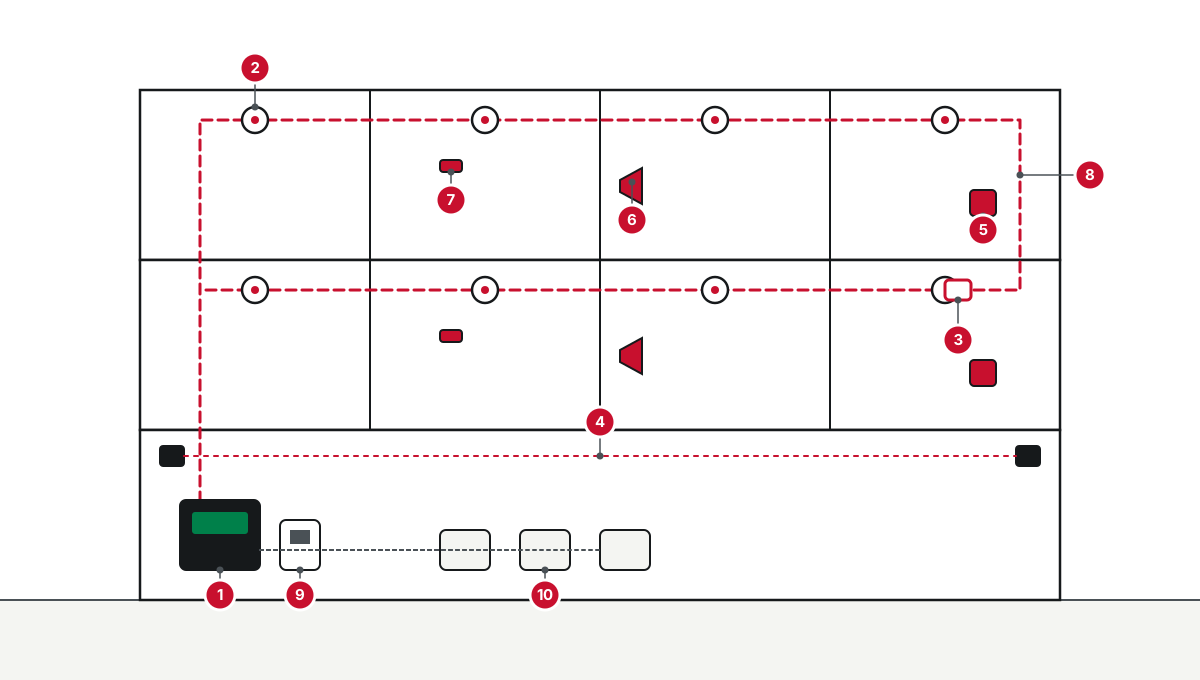
- Fire alarm control panel
- Optical smoke detector
- Heat detector
- Beam smoke detector
- Manual call point
- Hooter or sounder
- Response indicator
- Fire-resistant cable
- Talk-back and public address
- Interfaces
Fire alarm system code and key numbers at a glance
| What | The rule | Source |
|---|---|---|
| Standard | IS 2189:2026, Selection, Installation and Maintenance of Automatic Fire Detection and Alarm System, fifth revision, March 2026 | BIS, IS 2189:2026 |
| Replaced | IS 2189:2008, withdrawn on 17 September 2026 after 6 months alongside the new edition | BIS, IS 2189:2026 |
| Covers | Planning, design, selection, installation and maintenance, from a few call points to addressable panels (cl. 1.1) | BIS, IS 2189:2026 |
| Product standards | Detectors, call points, sounders and power supplies follow the IS/ISO 7240 parts, such as Part 11 for call points | BIS, IS 2189:2026 |
| Panel location | In the entrance lobby in plain view, never in a small lockable room or shaft (cl. 4.6) | BIS, IS 2189:2026 |
| Wireless systems | Allowed fully wireless or hybrid on licence-exempt bands such as 865 to 867 MHz (cl. 4.9) | BIS, IS 2189:2026 |
| Positive alarm sequence | Up to 180 seconds for trained staff to investigate before evacuation, only where the authority approves (cl. 6.3.2.9) | BIS, IS 2189:2026 |
| BIS mark for alarm products | Not compulsory: no Quality Control Order covered detectors, panels or alarms on 24 October 2026 | BIS, IS 2189:2026 |
| Detection versus sprinklers | The foreword says automatic detection is no substitute for sprinklers or other extinguishing systems | BIS, IS 2189:2026 |
| Life CPWD assigns a fire alarm system | 15 years | CPWD Maintenance Manual |
Types of fire alarm system: conventional vs addressable vs wireless
| Option | How the panel locates a fire | Largest zone | Typical use | Points to know | Source |
|---|---|---|---|---|---|
| Conventional | By zone: the panel shows which circuit, not which device | 2,000 m², search distance 30 m (cl. 4.4.2) | Small and medium buildings | Maharashtra's schedule rates price conventional, non-addressable items: a 2-zone panel Rs 16,632 | BIS, IS 2189:2026 |
| Addressable | By device: each detector and call point reports its own address | 3,000 m², search distance 30 m (cl. 4.4.2) | Large buildings, hospitals, hotels, campuses | Allows positive alarm sequence and health monitoring options in the 2026 code | BIS, IS 2189:2026 |
| Wireless or hybrid | Radio link to the panel, supervised like a wired loop | As for the wired type it replaces | Heritage buildings, temporary structures, retrofits, large campuses (cl. 4.9.7) | Maharashtra's circular 1420 of 16 October 2026 accepts it, but not in high-rise buildings | MFS circular 1420 |
Fire alarm system installation in 8 steps
Read the Table 7 row
Find whether the building needs a manual alarm only or manual and automatic detection, and whether talk-back and public address are added.
Plan the zones
Keep each zone within 2,000 m² (conventional) or 3,000 m² (addressable) and a 30 m search distance; stairwells, lift wells and shafts are separate zones (cl. 4.4.2).
Choose detectors for each space
Smoke or heat by the risk and ceiling height; beam or aspirating detectors above 10 m (cl. 6.3.3.1).
Lay out detectors and call points
Detector spacing by cl. 6.3, call points within 30 m of travel at 1.4 m (cl. 6.4), hooters at most 30 m apart (cl. 4.5.2).
Get the layout approved
Submit the detection drawings with the fire plan for the provisional approval your state runs.
Install panel, cabling and power
Panel in the entrance lobby (cl. 4.6); fire-resistant cable; mains supply with battery standby.
Commission and test
Operate every device, check fault signals on mains failure, run the general alarm for at least 5 minutes and voice systems for 15.
Certify and get the final NOC
The installer certifies the work (Form A by a licensed agency in Maharashtra) and the fire officer tests on site before the final NOC.
Fire alarm system components: 10 parts and what each does
Every system has devices that start an alarm, a panel that decides, and devices that warn people. The Maharashtra PWD schedule prices each of them as a separate item.
- Fire alarm control panel
- Receives signals, shows the zone or device, drives the sounders; sited in the entrance lobby in plain view (IS 2189 cl. 4.6). BIS, IS 2189:2026
- Optical smoke detector
- Senses smoke at the ceiling; spaced at up to 7.5 m on a flat ceiling up to 7 m high (cl. 6.3.2.1). BIS, IS 2189:2026
- Heat detector
- Senses temperature or its rise; spaced at up to 5.3 m on a flat ceiling up to 5 m high, and not used above 10 m (cl. 6.3.3.1). BIS, IS 2189:2026
- Beam smoke detector
- A light beam across a large space; the schedule lists 164 ft and 325 ft range models for large areas and passages. MH PWD CSR 2018-19, ch. 13
- Manual call point
- Break-glass or push device 1.4 m above the floor, within 30 m of travel from anyone (cl. 6.4). BIS, IS 2189:2026
- Hooter or sounder
- At least 75 dB(A) at the bed head with doors shut, never above 120 dB(A), at most 30 m apart (cl. 4.5.2, 4.5.3). BIS, IS 2189:2026
- Response indicator
- A remote indicator that repeats a hidden detector's operation where it can be seen; the schedule prices it as its own item at Rs 191. MH PWD CSR 2018-19, ch. 13
- Fire-resistant cable
- Armoured copper cable for detector loops; the schedule adds 7.5 percent for FRLS cable. MH PWD CSR 2018-19, ch. 13
- Talk-back and public address
- Two-way phones and speakers for staged evacuation, required with the manual alarm in hotels below 15 m with a floor over 1,000 m² (Table 7, Note 1). BIS, NBC 2016 Part 4
- Interfaces
- Sprinkler flow switches and the signal to the brigade or remote monitoring, which positive alarm sequence never inhibits (cl. 6.3.2.9.5). BIS, IS 2189:2026
How a fire alarm system works: from first smoke to evacuation
The path is the same in every system; an addressable panel simply names the device instead of the zone.
1. Detection or a call point
A detector senses smoke, heat or flame, or a person breaks a call point within 30 m of where they stand. BIS, IS 2189:2026
2. Signal to the panel
The panel shows the zone (conventional) or device (addressable) and sounds at a continuously attended point. BIS, IS 2189:2026
3. Optional investigation window
With positive alarm sequence approved, trained staff have up to 180 seconds; a second detector or any call point ends it at once (cl. 6.3.2.9.3). BIS, IS 2189:2026
4. General alarm
Hooters sound throughout at 75 dB(A) or more at the bed head (cl. 4.5.3); voice systems give staged messages. BIS, IS 2189:2026
5. Linked actions
The panel signals the brigade or remote monitoring and the fire command centre in large buildings (cl. 4.7). BIS, IS 2189:2026
Which buildings need a fire alarm system under NBC 2016 Table 7
Table 7 has an alarm column marked manual, or manual and automatic, by occupancy and height. These rows were read off the printed pages.
| Alarm under Table 7 | |
|---|---|
| Lodging house under 15 m, over 30 rooms | Manual |
| Flats and hostels under 15 m | None |
| Flats and hostels, 15 m to 60 m | Manual |
| Flats and hostels above 60 m | Manual and automatic |
| Hotel under 15 m, floor up to 300 m² | Manual |
| Hotel under 15 m, floor over 300 m²; five-star hotel | Manual and automatic |
| School under 15 m; school 15 m to 24 m | None; manual |
| Hospital with beds above ground plus 2, or 15 m to 24 m | Manual and automatic |
| Assembly under 10 m up to 300 persons; above 15 m | Manual; manual and automatic |
| Mall with cinemas or food courts | Manual and automatic |
| Office under 10 m; office above 15 m | Manual; manual and automatic |
| Shops ground plus one up to 500 m²; shops above 15 m | None; manual and automatic |
| Moderate hazard factory over 1,000 m²; warehouse over 250 m² | Manual and automatic |
| Multi-level car park | Manual only |
Manual means call points and sounders; automatic adds detectors. The full rows with risers, sprinklers and tanks are on the NBC 2016 page. NBC 2016, Table 7
Which fire alarm detector for which space: smoke, heat, beam or flame
IS 2189:2026 clause 6.3 picks the detector by ceiling height and the place, not by price.
IfAn ordinary room or office with a flat ceiling up to 7 m
Point smoke detectors at up to 7.5 m spacing, sensing element 25 to 600 mm below the ceiling (cl. 6.3.2.1). BIS, IS 2189:2026
IfA ceiling from 7 m to 10 m
Smoke detector spacing drops to 5 m; heat detectors to 3.5 m between 5 m and 10 m (cl. 6.3.3.1). BIS, IS 2189:2026
IfA ceiling above 10 m, such as a warehouse or atrium
Beam or aspirating smoke detectors, or flame detectors; heat detectors are not allowed (cl. 6.3.3.1). Warehouses BIS, IS 2189:2026
IfA corridor narrower than 2 m
Smoke detectors up to 12 m apart, heat detectors up to 8 m (cl. 6.3.2.8). BIS, IS 2189:2026
IfA false ceiling or floor void deeper than 800 mm
Protect the void like a room; voids under 800 mm only if smoke can spread through them (cl. 6.3.2.6(j)). BIS, IS 2189:2026
IfStairs, lift wells, shafts and lift machine rooms
A detector at the top of each stair and on each main landing, each shaft its own zone (cl. 6.3.2.6, 4.4.2(e)). BIS, IS 2189:2026
IfA factory
The DGOSH Model Rule and Gujarat's rule 66-A want a manual alarm where over 500 persons work, or more than 25 above or below the ground floor, unless an automatic alarm is fitted. Factories Gujarat DISH
Fire alarm detector spacing and coverage numbers
Six numbers from IS 2189:2026 set the layout of most Indian detection systems.
7.5 m
Smoke detector spacing on a flat ceiling up to 7 m high (cl. 6.3.2.1) BIS, IS 2189:2026
5.3 m
Heat detector spacing on a flat ceiling up to 5 m high (cl. 6.3.2.1) BIS, IS 2189:2026
100 m²
At least 1 smoke detector for each 100 m² as a cross-check on the layout; 50 m² for heat (cl. 6.3.4) BIS, IS 2189:2026
2,000 m²
Largest zone, conventional system; 3,000 m² addressable (cl. 4.4.2(a)) BIS, IS 2189:2026
300 m²
Total building area below which one zone may cover more than one floor (cl. 4.4.2(b)) BIS, IS 2189:2026
750 mm
Clear radius kept below every detector, checked quarterly BIS, IS 2189:2026
Fire alarm manual call point and hooter placement: do's and don'ts
Call points and sounders are where most inspection remarks fall. IS 2189:2026 sets them in clauses 4.5 and 6.4.
Do
- Mount call points 1.4 m above the floor (cl. 6.4(d)). BIS, IS 2189:2026
- Keep every person within 30 m of travel of a call point, or 45 m where call points are also outside (cl. 6.4(b)). BIS, IS 2189:2026
- Give a call point a side profile of at least 15 mm where it cannot be seen from the front (cl. 6.4(e)). BIS, IS 2189:2026
- Fix wall hooters at least 2,290 mm above the finished floor and at most 30 m apart (cl. 4.5.2). BIS, IS 2189:2026
- Reach at least 75 dB(A) at the bed head with doors shut in sleeping areas (cl. 4.5.3). BIS, IS 2189:2026
Don’t
- Do not exceed 120 dB(A) anywhere people are (cl. 4.5.3). BIS, IS 2189:2026
- Do not put the panel in a small lockable room or a shaft (cl. 4.6). BIS, IS 2189:2026
- Do not fit wireless detection in a Maharashtra high-rise: circular 1420 of 16 October 2026 excludes it. MFS circular 1420
- Do not test smoke detector sensitivity with an unmeasured aerosol dose; cl. 7.2.7 asks for a calibrated test. BIS, IS 2189:2026
Fire alarm talk-back, public address and voice evacuation in high-rise buildings
A plain hooter is not enough in tall or large buildings. Three instruments add voice systems on top of the alarm.
NBC 2016
Hotels with floors over 1,000 m²
Table 7 Note 1 adds talk-back and public address to the manual alarm in hotels below 15 m once a floor exceeds 1,000 m². BIS, NBC 2016 Part 4
Maharashtra
Apartments from 24 m
Note 1 of Schedule-I, substituted in 2023, asks for talk-back and public address in apartment buildings from 24 m. MH Act 2023 Schedule-I
NBCS 2026
Offices of 500 to 1,000 m² and larger homes
Part F's tables pair detection with a public address and voice evacuation system, for example in CL-2 offices; binding only where a state adopts it, as Assam has. BIS, SP 7:2026
IS 2189:2026
Testing voice systems
Run voice evacuation for at least 15 minutes in the yearly test, against 5 minutes for a general alarm. BIS, IS 2189:2026
Fire alarm system commissioning and yearly test checklist
IS 2189:2026 clause 7 and Table 4 list the tests a competent contractor makes; use the same list at handover.
- Every smoke detector functionally tested in place. BIS, IS 2189:2026
- Heat detectors tested with a heat source or as the maker directs. BIS, IS 2189:2026
- Every manual call point operated. BIS, IS 2189:2026
- Mains power disconnected and the trouble signal checked; the panel runs on battery. BIS, IS 2189:2026
- General alarm run for at least 5 minutes; voice systems for at least 15 minutes. BIS, IS 2189:2026
- Sound level of at least 75 dB(A) at the bed head with doors shut (cl. 4.5.3). BIS, IS 2189:2026
- Sprinkler flow switch and brigade link signals reach the panel. BIS, IS 2189:2026
- Any deficiency not fixed by the end of testing reported to the owner in writing within 24 hours. BIS, IS 2189:2026
Fire alarm system maintenance checklist: daily to every 5 years
IS 2189:2026 splits upkeep between the user and a competent contractor; Maharashtra's July 2026 guidelines add longer cycles.
Daily
Panel shows normal; yesterday's faults logged and being fixed; panel not dead from a fuse, supply fault or switch-off. BIS, IS 2189:2026
Weekly
One device per zone tested, so no zone goes untested for more than 13 weeks. MFS Form B guidelines
Every 3 months
Detectors cleaned; log book reviewed, batteries and connections tested, a device in each zone and the sounders operated, 750 mm clear below every detector. BIS, IS 2189:2026
Yearly
Every smoke detector, heat detector and call point tested; general alarm for 5 minutes. BIS, IS 2189:2026
Every 3 years
Electrical installation of the system tested. MFS Form B guidelines
Every 5 years
Every device tested. MFS Form B guidelines
Fire alarm system price and cost: official item rates
Flamekite’s working from the official rules; no government publishes this figure.
The Maharashtra PWD Current Schedule of Rates 2018-19 prices conventional (non-addressable) alarm items, supplied, installed, tested and commissioned, GST extra. No official schedule read prices addressable items.
As published
- Optical smoke detector with base (item 13-8-2)Rs 1,632 MH PWD CSR 2018-19, ch. 13
- Heat detector with base (13-8-1)Rs 1,521 MH PWD CSR 2018-19, ch. 13
- Manual call point, break glass, metal box (13-8-5)Rs 510 MH PWD CSR 2018-19, ch. 13
- Hooter in CRCA enclosure (13-8-6)Rs 596 MH PWD CSR 2018-19, ch. 13
- Response indicator (13-8-7)Rs 191 MH PWD CSR 2018-19, ch. 13
- 2-zone conventional fire alarm panel (13-8-12)Rs 16,632Add 25 percent of the rate for each extra zone MH PWD CSR 2018-19, ch. 13
- Beam smoke detector, 164 ft range (13-8-3)Rs 30,985325 ft range Rs 50,620 MH PWD CSR 2018-19, ch. 13
- FR XLPE armoured cable, 2 core 1.5 mm² (13-8-8)Rs 91 a metre4 core Rs 112; add 7.5 percent for FRLS MH PWD CSR 2018-19, ch. 13
- Public address amplifier, 120 W (13-9-1)Rs 16,29815 W sound column Rs 2,475 MH PWD CSR 2018-19, ch. 13
Rates took effect on 12 September 2018 and apply to Maharashtra PWD works; a 4-zone panel works out at Rs 24,948 by the schedule's 25 percent rule. Current CPWD rates were not available to read.
Fire alarm faults that hold up a fire NOC
Each of these is a visible departure from IS 2189:2026 or the Table 7 row.
If Manual alarm only where Table 7 marks manual and automatic
Add detectors; a hotel with floors over 300 m² or an office above 15 m needs both. NBC 2016, Table 7
If A zone larger than 2,000 m² on a conventional panel
Split the zone, or move to addressable with its 3,000 m² limit (cl. 4.4.2). BIS, IS 2189:2026
If Panel in a locked electrical room
Move it to the entrance lobby in plain view (cl. 4.6). BIS, IS 2189:2026
If Heat detectors under a 12 m roof
Replace with beam, aspirating or flame detection above 10 m (cl. 6.3.3.1). BIS, IS 2189:2026
If Hooters inaudible in bedrooms
Add sounders until 75 dB(A) is reached at the bed head with doors shut (cl. 4.5.3). BIS, IS 2189:2026
If No talk-back or public address in a 24 m Maharashtra apartment block
Schedule-I Note 1 asks for both from 24 m. MH Act 2023 Schedule-I
Fire alarm myths that IS 2189 contradicts
Four common beliefs that the 2026 text and Table 7 do not support.
You may have read
A fire alarm replaces sprinklers.
Myth
What the sources say
The IS 2189 foreword says detection is no substitute for sprinklers or other extinguishing systems, and Table 7 asks for both in most larger buildings. BIS, IS 2189:2026
You may have read
IS 2189:2008 is still the code.
Myth
What the sources say
BIS withdrew it on 17 September 2026; IS 2189:2026 is the only edition. BIS, IS 2189:2026
You may have read
Every apartment block needs smoke detectors.
Myth
What the sources say
Table 7 asks for no alarm in flats under 15 m and a manual alarm only from 15 m to 60 m; automatic detection starts above 60 m. NBC 2016, Table 7
You may have read
Detectors are compulsorily ISI marked.
Myth
What the sources say
No Quality Control Order covered detection or alarm products on 24 October 2026. BIS, IS 2189:2026
Fire alarm requirement for 3 buildings: worked examples
Flamekite's reading of Table 7 and IS 2189:2026 in states that name NBC 2016. The fire service's reading prevails.
Case 1
A 25 m block of flats
Group A-4, ground plus 7, no basement.
What applies Manual alarm only: call points within 30 m of every flat door path and hooters at most 30 m apart. In Maharashtra, talk-back and public address are added from 24 m. NBC 2016, Table 7
Case 2
A ground plus 2 hotel with 600 m² floors
Group A-5, 11 m.
What applies Floors over 300 m², so manual and automatic: smoke detectors in rooms and corridors, a panel in the lobby, 75 dB(A) at each bed head. NBC 2016, Table 7
Case 3
A 2,800 m² single-floor warehouse with a 12 m roof
Group H, ground floor only.
What applies Manual and automatic detection. Above 10 m, beam or aspirating smoke detection; two conventional zones or one addressable zone of 3,000 m² or less. BIS, IS 2189:2026
What Flamekite could not confirm about fire alarm systems
Four claims seen on the web that no official text read on 28 October 2026 supports.
- That NBC 2016 requires an addressable system above 45 m: Table 7 marks manual or automatic, not the panel type.
- That hospital accreditation requires an addressable panel: no official text was read.
- Official rates for addressable panels and devices: the Maharashtra schedule prices conventional items only.
- HSN code and GST rate for alarm installation: not confirmed from a CBIC or GST Council notification.
Questions about fire alarm systems in India
What is a fire alarm system?
What are the types of fire alarm system?
How does a fire alarm system work?
What is the difference between conventional and addressable fire alarm systems?
What are the components of a fire alarm system and their parts names?
Which IS code applies to fire alarm systems?
Which buildings need a fire alarm in India?
What is the height of a manual call point?
How far apart are smoke detectors placed in a fire alarm system?
How often should a fire alarm be tested?
What is the price of a fire alarm system in India?
Are wireless fire alarms allowed in India?
Keep reading
- IS 2189: detection and alarm codeEvery clause value, 2026 changes, wireless and positive alarm sequence.
- Fire alarm system MCQ42 practice questions on IS 2189, each answer cited to its clause.
- Fire fighting contractorsWho may install a fire alarm system and sign the state certificates.
- Fire AMCHow alarm testing becomes a yearly maintenance contract.
- Fire hydrant systemWet risers, yard hydrants, pumps and official rates.
- Fire suppression systemGas and kitchen systems the alarm panel triggers.
- Fire fighting systemEvery installation a building needs, by NBC Table 7.
- Fire sprinkler systemTypes, hazard classes, IS 15105 design and rates.
Free tools for this
- Fire Fighting System Cost EstimateFire fighting system cost estimate at official rates: enter sprinkler heads, hydrants, detectors, pumps and pipe for a BOQ at Maharashtra PWD schedule rates
- Fire Extinguisher HSN Code and GST RateHSN and SAC codes with GST rates for fire extinguishers, pumps, hoses, alarms, AMC, audit and fire NOC consultancy, read from the CBIC rate notifications
Keep exploring
The codes and laws behind it
Sources
Each source was opened and read on the date shown. How Flamekite checks its sources
- Bureau of Indian Standards: IS 2189:2026, Selection, Installation and Maintenance of Automatic Fire Detection and Alarm System, Code of Practice (fifth revision), March 2026; free download after registration; clause numbers cited on the page (opens in a new tab)
- Bureau of Indian Standards (BIS-licensed copy hosted by Nagpur Municipal Corporation): National Building Code of India 2016, Part 4, Table 7 Minimum Requirements for Fire Fighting Installations: every row, Groups A to J, and Notes 1 to 24, printed pages 41 to 51, read off the page images (opens in a new tab)
- Public Works Department (Electrical Wing), Government of Maharashtra (copy hosted by Chhatrapati Sambhajinagar Municipal Corporation): Current Schedule of Rates 2018-2019 (in force from 12 September 2018), chapter 13 Fire Fighting and Fire Alarm System: items 13-1-1 to 13-10-3 (fire pumps, jockey and booster pumps, GI pipe, valves, hydrant valves, hose reels, hoses, branch pipes, fire brigade inlets, cabinets, conventional fire alarm, PA system and sprinkler items), rates per unit before GST, printed pages 223 to 231 (opens in a new tab)
- Bureau of Indian Standards, Know Your Standards database: Status, publication and withdrawal dates of the fire standards named on /is-codes (IS 2190, 15683, 16018, 2189, 15105, 9972, 3844, 13039, 9668, 15301, 15908, 636, 884, 903, 5290, 9457, 3614, 11360, 2175 and others), read 24 October 2026 (opens in a new tab)
- Central Public Works Department, Government of India: CPWD Maintenance Manual 2023: services not rendered by CPWD, plinth-area rates for electrical maintenance (Annexure 2A), use of indexed DSR or market rates, and life of fire alarm and wet riser systems (opens in a new tab)
- Bureau of Indian Standards (BIS-licensed copy hosted by Nagpur Municipal Corporation): National Building Code of India 2016, Part 4: Table 7 rows (d) hotels (A-5) and (e) hotels (A-6) with Notes 1 to 15, clause 4.10.1 (Fire Officer for starred hotels) and clause 6.1.1.4 (Subdivision A-5), read off the page images (opens in a new tab)
Show all 12 sourcesShow fewer
- Directorate of Industrial Safety and Health, Government of Gujarat: The Gujarat Factories Rules, 1963: rule 66 means of escape in case of fire and rule 66-A fire protection (inserted 15 February 1995), with Schedules I and II (opens in a new tab)
- Maharashtra Fire and Emergency Services: Circular No. MFS-2026/1420, 16 October 2026: Wireless Detection System, under IS 2189:2026 clause 4.9 (number and date read from the page image) (opens in a new tab)
- Government of Maharashtra (gazette copy hosted by Maharashtra Fire and Emergency Services): Maharashtra Fire Prevention and Life Safety Measures (Amendment) Act, 2023, substituted Schedule-I: minimum fire fighting installations for apartment houses (A-4) by height, with Notes 1, 4, 6, 10, 11 and 15 (read off the page images, pp. 13 to 15 and 32 to 34) (opens in a new tab)
- Bureau of Indian Standards (copy hosted by Goa Directorate of Fire and Emergency Services): SP 7:2026 National Building Construction Standards 2026, Part F: Fire and Life Safety (opens in a new tab)
- Maharashtra Fire and Emergency Services: Guidelines for Form B, Annexure A: to be followed by licensed agencies issuing Form B under section 3(3) and rule 4(2) (circular of 7 July 2026) (opens in a new tab)
- Studio Matrx (consumer guide): Conventional vs addressable fire alarm in India (competitor page read for its section count) (opens in a new tab)